Assassin's Creed Odyssey - New Game - Hard (Full Playthrough, from Lv1 to Lv 82)

As much as I love replaying Odyssey, in my opinion nothing beats that first time exploration and discovering everything from the beginning. For this reason, I decided to record a playthrough in New Game, where I start from Level 1 and get everything from the start. There is a lot of grinding of course, which for some people may be tiresome or boring, but personally I enjoy it in this kind of games, and Odyssey especially which, moreover, is among the games that I love the most. My intention was to reach Level 99+, but after covering everything (and more), the highest that I managed to achieve was Level 82.

What I cover:

Basically all the stories and everything that is on the map, namely:

-The main Odyssey story

-The modern day story

-The Gates of Atlantis (the four artifacts)

-From The Shadows (the Cultists questlines)

-Legacy of the First Blade

-The Lost Tales of Greece and the two special blue-colored bounties

-The Heir of Memories including the three Underworld episodes (Elysium, Underworld, Atlantis)

-The Korfu addendum

-All the quests that are / appear on the map with the yellow exclamation mark

-A few random extra quests that are triggered after a certain action is done

-All map objectives that are marked with a question mark, including tombs, forts, camps and caves, temples, underwater locations, leader houses and other buildings and points of interest.

-All legendary items including armors and weapons that can be found by killing mercenaries or looting legendary chests.

How I play:

Instead of upgrading stuff, I rather switch to stronger weapons when I find them and regularly dismantle those that I don't use. Same goes for armor pieces, which may result in Alexios having a weird or even funny look at times due to random combinations, but I don't mind that and I also find it a bit entertaining, to be honest. I don't do any engravings, and instead I invest in upgrading the ship, which is vital for the naval battles later on.

Each episode covers one region (or more in a few cases when they are brief), with the necessary occasional backtracking or side-tracking to start or (fully or partly) complete a quest or kill a cultist. Most episodes include several quick backtrackings, but the respective regions are not included in the titles - for instance, Phokis is not listed every time that I return to Daphne, nor is Attika whenever I return to Demosthenes, but usually (if not always) backtrackings of this kind are done at the end of each episode. Sometimes I may intentionally leave out certain areas because I know I will be backtracking there in a later episode. For example, because the Lost Tales of Greece do not become available until after you complete the main quests in Athens, you cannot go for the two of them (Daughters of Lalaia and Socrates's Trial) that take place in Phokis the first time you visit that region. So I ignore some of the map objectives there in order to complete them when I revisit Phokis for those two quests. Because I may pass from areas, however, without going for quests the first time, weird things may happen, like the pirate ships from "A Really Really Bad Day" being destroyed long before said questline is initiated. I guess such goofy things are doomed to happen anyway.
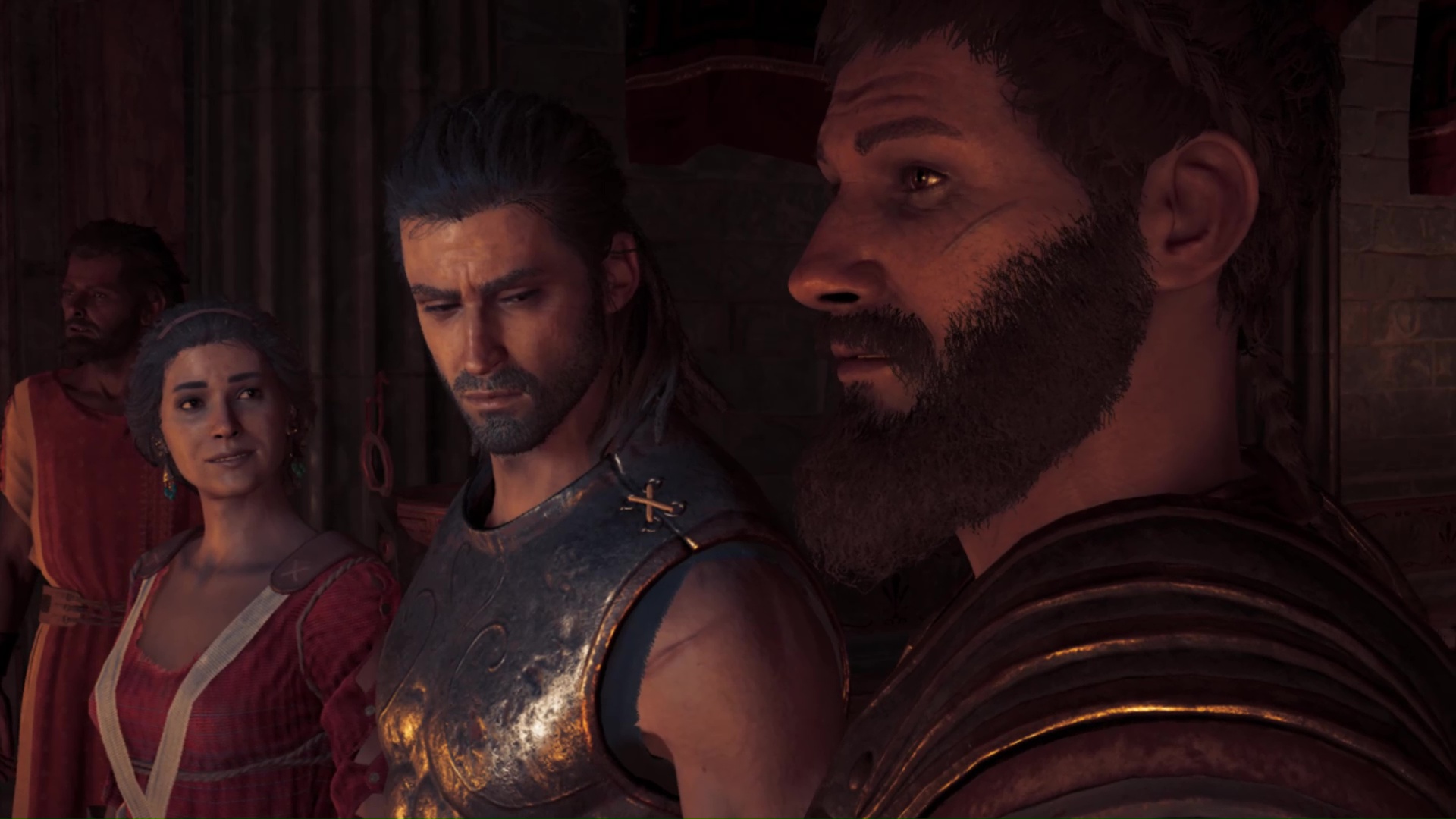

Difficulty level:

I wasn't sure if I should go for Hard or Nightmare for a New Game playthrough, but I finally decided to go with Hard for three main reasons:

-Since it takes a long time to decently upgrade the ship, the Adrestia is quite weak for most part of the main story, which renders certain naval battles a royal pain in the arse when you play in Nightmare.

-There are a few parts in Legacy of the First Blade that are really exhausting in Nightmare, and since this DLC is not my favorite anyway, I didn't want to complicate things further.

-Certain quests in the Atlantis episode, namely hunting down the Dikastes's armor pieces, are extremely difficult because the Isu polemarchs that hold said pieces are insanely strong and resilient, so I needed this to be a bit toned down since Alexios is not super-powerful yet.

Playlist:

Links to individual parts: 

Part #1 - Kephallonia & Ithaka: https://youtu.be/BEFrTFDTmCo
Part #2 - Megaris: https://youtu.be/5eRXJ4l9pnU
Part #3 - Phokis: https://youtu.be/CbC5iw5wljU
Part #4 - Abantis Islands & Andros: https://youtu.be/Vfs7FHxHDi4
Part #5 - Attika: https://youtu.be/BuUN8cYSuQM
Part #6 - Phokis Redux, Malis & Lokris: https://youtu.be/s8-Zu57M36k
Part #7 - Argolis: https://youtu.be/nrmO_qOEjFs
Part #8 - Korinthia: https://youtu.be/O8rTZSs3hz0
Part #9 - Attika Redux & Obsidian Islands: https://youtu.be/kRo9Cu_nTuY
Part #10 - Pirate Islands, Salamis & Athens: https://youtu.be/r0wn5GNDwyc
Part #11 - Naxos & Paros: https://youtu.be/wh8daCATm2w
Part #12 - Makedonia: https://youtu.be/u05-_evhikg
Part #13 - Thera & Kythera: https://youtu.be/8xxRIaAg7PE
Part #14 - Achaia: https://youtu.be/XtJ7Oq0pjFc
Part #15 - Messenia: https://youtu.be/IxH_AsJa3wE
Part #16 - Lakonia: https://youtu.be/g_kuvnpUY-M
Part #17 - Elis: https://youtu.be/OEvsk6POYw8
Part #18 - Boeotia: https://youtu.be/1y4AH1VG_m4
Part #19 - Hephaistos Islands: https://youtu.be/dMBysDPwK58
Part #20 - Arkadia, Sparta & Pylos: https://youtu.be/z6378C6y7fI
Part #21 - Athens & Elis Redux, Amphipolis, Sparta & Boeotia Redux: https://youtu.be/Gx-BKFWxUsA
Part #22 - Krete: https://youtu.be/1kz0QC68YS0
Part #23 - The Silver Islands: https://youtu.be/hOM-xqQcSC8
Part #24 - Petrified Islands: https://youtu.be/IQO7ampWe4I
Part #25 - Thera Redux, Southern Sporades, Serifos, Argolis, Boeotia & Attika Redux: https://youtu.be/q8giP8Xdn1g
Part #26 - Elysium: https://youtu.be/th225IF1uPk
Part #27 - Underworld: https://youtu.be/N9_3EBbiSmY
Part #28 - Atlantis: https://youtu.be/5B78GmrByAU
Part #29 - Korfu: https://youtu.be/Ya5lsgTzfMs

Shadow of the Tomb Raider - Deadly Obsession Longplay

I recently reinstalled this gorgeous game in order to play its seven DLC stories that I already had aquired but had forgotten about them completely. They turned out to be absolutely wonderful, but in the process I realized that although I own the game since many years now, I had never attempted to play it in its hardest difficulty level, which is Deadly Obsession.

In reality, Deadly Obsession is not exactly a difficutly level. If you have played the game in its standard hardest mode, One With the Jungle, you already have mastered its most difficult version. Deadly Obsession is essentialy the One With the Jungle difficulty minus the automatic checkpoints. You can only save on base camps, and thankfully the game offers a few free checkpoints during sequences that are too extended or too demanding, namely: 

-During the prologue, due to the lack of base camps, there is one free checkpoint just before you meet the local archaeologist outside the dig site.

-Again during the prologue, there is one more checkpoint when the flood begins.

-After the plane crashes and you find yourself in the Peruvian Jungle (kind of useless since there is a base camp pretty close).

-After leaving Paititi on boat and Rourke's helicopter attacks, Lara finds herself alone on the beach of the Porvenir oil fields. There is a checkpoint just before the series of areas where you need to move with stealth because you have no weapons.

-In San Juan, there is one last checkpoint at the beginning of the mudslide (thank God for that, because I died about a dozen times during that evil mudslide).

I played Deadly Obsession in New Game Plus mainly because I wanted to stay focused on the progression of the game without having to worry about leveling up, which would require going for side quests and challenge tombs so as to gain as many XP as possible. Lara is wearing the outfit of Six Sky for the most part, which helps avoiding a certain amount of damage from projectiles and regenerating health faster. As I mentioned above, the actual level of difficulty in Deadly Obsession is more or less the same as in One With the Jungle. What makes Deadly Obsession so nasty is the lack of checkpoints, which results in certain sequences being extremely hard to complete, not because they are difficult but because of all that climbing and jumping where there is hardly any room for mistakes. Playing with all skills or with no skills doesn't make much of a difference, because you are much more likely to die from a stupid fall or a miscalculated jump than from gunfire. I would say that the percentage is 90%-10% (90% for fall deaths, and 10% for the gunfire), or even 95%-5%. To be more specific, there are certain sequences that are guaranteed to test your nerves and your patience.

-The Trial of the Eagle. This whole part is a test of precision, where most of the times you will find yourself being knocked off to your death by an unforgiving beam. And when you finally manage to reach the top, you will most likely miss that last jump to solid ground. But at least there is a base camp just before the trial room, so you "only" need to repeat the whole trial over again.

-The Cenote stage. The lack of base camps in this section is pure evil. The stage per se is alright, with maybe the first Yaaxil ambush taking you by surprise, but I died only once during that part, and in the end I was able to kill most of them with Dodge Kills, preserving lots of valuable ammo. The water puzzle itself is quite easy to memorize, and the subsequent part where you need to escape the Cenote can be done easily too. But then it's the hard road back to Paititi. Although "road" isn't the word to describe it. You need to make a series of jumps above an abysmal chaos, where Lara suddenly may decide to commit suicide for no obvious reason. This means that you are then forced to repeat the whole Cenote part from the beginning, only to find yourself again in the dreaded situation of falling to your death while struggling to perform a lateral jump inside a peaceful, enemy-free cave. 

-The sequence where you go to free Unuratu. The path to her cell involves a ton of climbing and jumping, and several times you will find yourself totally helpless while witnessing Lara falling right into the raging waters and breaking all her bones on the rocks. Then you will be holding your breath while struggling to survive the ambush in the yard of the Emperor's Tomb, although technically this should not be as bad as it looks as long as you have resources to keep crafting special ammo and are able to move around with stealth.

-The Porvenir Oil Fields. There is a base camp just before the second part, which I thought I would take advantage of to go back and save after completing a new area. It worked for the first area, but when I went back to save again after the second one, I saw that the enemies there had respawned. I don't know if this was done on purpose or if it's a leftover, but it was very annoying, and more so because there is again a nasty sequence with jumps afterwards, where of course Lara had to suffer a humiliating death more than once. I wanted to make those saves because I was dreading the helicopter part at the Refinery, but this went surprisingly well.

Overall Deadly Obsession was quite an experience which however I don't know if I am ready to relive any time soon. I also got the achievement with this run, but unfortunately Bandicam does not record Steam pop-ups, so it didn't capture the achievement popping up. My general impression is that, when it comes to games that rely so much on their platformer aspect, it is very risky to not give the players the chance to save more often (or at least change the placing of save points to be a bit more forgiving) when it comes to challenges like Deadly Obsession. Resident Evil 3's Inferno and The Evil Within's Classic Mode also don't have checkpoints, but those are both games that rely almost entirely on the player's strategy and you are able to be in total control almost all the time. In games like Shadow of the Tomb Raider, where you are many times found in the tough position to perform series after series of very risky jumps in between demanding battle sequences, a few more checkpoints or a couple more bonus base camps could make a huge difference and save us from unnecessary extra frustration.

Tomb Raider I: Atlantean Scion & Unfinished Business Playthrough


The last playthrough in my Tomb Raider Nostalgia Series is that of the very first game, both of the classics and the series as a whole. The original Tomb Raider game is a pure vintage gem with so much sentimental value that it makes up for the fuss that you have to go through in order to decently run and record it on a modern computer system. 

The resolution is a bit low in the main game, but everything is smooth and running well in Unfinished Business, the Gold expansion, which, by the way, is one of the two classic Tomb Raiders that I have played less (along with The Lost Artifact, as I mentioned in my Tomb Raider III report). Now playing UB again, I remembered why: although it is beautiful visually and very elaborate as far as gameplay and puzzles are concerned, I soon got fed up with those mutant mummies with their annoying (insert non-decent characterization here) screeching noises. Regardless, the Gold expansion, like the main game, is a lovely game, and very interesting too from a technical aspect, because in it you can see how elements from the main game were expanded to an impressive degree.

Like with all previous playthroughs of this series, I don't go for all pickups and kills (although I complete most of these objectives), but I do find all the secrets in every level. I have again split the playthrough in parts, one per region.

Part 1 is Peru: Caves, City of Vilcabamba, The Lost Valley, Tomb of Qualopec.

Part 2 covers the Greco-roman levels: St Francis' Folly, The Colosseum, Palace Midas, The Cistern, Tomb of Tihocan.

Part 3 is Egypt: City of Khamoon, Obelisk of Khamoon, Sanctuary of the Scion.

Part 4 is Atlantis: Natla's Mines, Atlantis, The Great Pyramid.

The last part includes the four levels of the Gold expansion "Unfinished Business": Return to Egypt, Temple of the Cat, Atlantean Stronghold, The Hive.


Tomb Raider III: Adventures of Lara Croft & The Lost Artifact Playthrough

Next up in my Tomb Raider Nostalgia Playthrough Series is Tomb Raider 3, the third installment of the classics. There were quite a few innovations in this game compared the to the first and the second, the most memorable being the fact that, after the first section was completed, you could play the subsequent three adventures in any order you wanted. Like in Tomb Raider 2, a brief but fabulous bonus level would unlock if you completed the game with all secrets found.

Since these playthroughs are going to be a one-time thing - that is, I will probably won't be replaying the classic Tomb Raiders in full, any time soon at least - I am trying to cover as much stuff as possible. Random kills or pickups that have no interest or are simply in the regular path, may be left behind, but I do find all the secrets and if there is exploration involved (including pickups) in areas that are optional, I go for them as well. In this game in particular, I am referring to the legendary River Ganges level from the India section, where at some point you have to choose between two possible paths. At first, covering both paths was considered impossible, but later several players found out a way to visit them both. In my playthrough, I also do this; I cover both paths so as to explore as much of the terrain as possible. All this involves some really tricky jumping that may even put to shame many contemporary games that are considered difficult in that aspect. You can choose between paths in other levels as well, but in those cases you cannot cover both alternatives, so I will be taking the longest possible path.

This game includes one of the toughest sequences I have ever encountered in gaming - and trust me, I have played many difficult games! I am referring to the notorious kayak sequence in the Madubu Gorge stage of the South Pacific Islands section. Driving any vehicle is a tough business in the old Tomb Raider games, but the kayak is on another level. In fact it is almost literally an up-the-creek-without-a-paddle kind of level, almost because you do have a paddle but it's a royal pain in the ass anyway because even though you have a paddle, those wild rapids are definitely the devil's work. At the same time, it's a quite fascinating experience, because who can forget the impressive finale with Lara driving the kayak down that roaring whirlpool.

Tomb Raider 3 also includes one of my most cherished sections, the one that takes place in London. This section is perfection, even with today's standards. In its turn, it features one of the most difficult sequences in the whole series, the flooded / underwater section of the Lud's Gate stage. Like in the Tomb Raider 2 playthrough, in this one too I have included its Gold expansion, The Lost Artifact. Each video covers one section of the main game, and the Lost Artifact has its own separate video.

A NOTE ABOUT THE LOST ARTIFACT: this is the one of the two classic Tomb Raider games that I have played the least (along with TR1's Gold expansion) - which is weird, by the way, given how much I like most of it. Moreover, the only working version of it that I could find (that is, the only version that would even load on my Win11 PC) was an extremely buggy one that featured every single bug that has been reported so far concerning this game. For these reasons, I didn't insist much on achieving good scores, as I just wanted to record a playthrough for historical reasons mainly. Regardless, all secrets are again included, as well as almost all the pickups that are well-hidden or require taking complex routes.

Part 1 is India, the introductory section including: Jungle, Temple Ruins, The River Ganges, Caves of Kaliya.

Part 2 is Nevada: Nevada Desert, High Security Compound, Area 51.

Part 3 is the South Pacific Islands section: Coastal Village, Crash Site, Madubu Gorge, Temple of Puna.

Part 4 is London: Thames Wharf, Aldwych, Lud's Gate, City.

Part 5 is Antarctica: Antarctica, RX Tech Mines, Lost City of Tinnos, Meteorite Cavern.

Part 6 is the bonus level, All Hallows.

The last part is a longplay of The Lost Artifact.

Tomb Raider: Chronicles Playthrough

Going on with my Tomb Raider Nostalgia Playthrough Series, I am now playing Tomb Raider: Chronicles, the fifth game of the classics.

I remembered Chronicles fondly, and when I started to play it again after so many years I realized why, but then I got to the notorious VCI section and everything got a bit messy. The last three levels of the game are among the best of the classic Tomb Raiders, and maybe the most original and innovative compared to the rest of the series of that era, but at the same time they are so hard and so incredibly buggy that eventually the VCI adventure turns into an assemblage that could only be compared to Stefano Valentini's morbid creations: on the one hand the bugs can be hellish; from frustrating to literally game-stopping. Although sometimes said bugs may also have fortunate outcomes: as you will see in my video, at some point I tried to make Lara stealthily neutralize a guard, which she refused to do; at that point, the guard surprisingly turned around and left the room, totally ignoring her, so I managed to go on with the level undisturbed. In an other section, a ceiling trapdoor that was supposed to open never did so, but Lara was nonetheless able to climb in the room above; the consequence of this was that two extra guards that were supposed to appear when the trapdoor would open, never showed up. I am not complaining for bugs like these. On the other hand, there is great atmosphere in the VCI, fantastic stealth sequences, enemies that are not only tougher than usual but also cunning, and some of them have traits or accessories that make them extremely hard to kill. Lara doesn't have her trademark pistols, which means we don't have the unlimited ammo luxury available, and the developers have implemented new elements, like having Lara equip a rifle with a scope for the first time, as well as a grappling gun, and use chloroform to neutralize the enemies while moving with stealth. Considering all that stuff in retrospect, I am thinking now that the three VCI levels (The 13th Floor, Escape With The Iris and Red Alert!) were maybe an attempt to prepare the ground for a - then - future Tomb Raider that would probably shift towards a different direction, a game that could have elements of stealth and heavy action involved; something that unfortunately never happened back then.

Setting that aside, however, the rest of Chronicles is pure old Tomb Raider as far as the stories and the environments are concerned, with the Rome section being a reminiscent of Venice from Tomb Raider 2, and the Submarine levels bringing back memories from Tomb Raider 3's Antarctica. The Ireland section, in which we get to play with a teenage Lara, is also somewhat different, because our heroine doesn't have any weapons in those levels - thankfully there are neither enemies that need to be shot - and the whole story is set around local folklore and magic.

Like in the previous - as well as in the upcoming - playthroughs of the classic Tomb Raiders, here too I am not going for all kills or pickups, but I do find all secrets in each level. That said, if a pickup is very tricky and challenging, I do go for it anyway for the sake of exploration and discovery which are both so important in Lara's adventures. My playthrough is split in four parts: 

Part 1 is Rome: Streets of Rome, Trajan's Markets, The Colosseum.

Part 2 is The Submarine: The Base, The Submarine, Deepsea Dive, Sinking Submarine.

Part 3 is Ireland: Gallows Tree, Labyrinth, Old Mill.

Part 4 is the VCI Headquarters: The 13th Floor, Escape With The Iris, Red Alert!

At the end of the VCI section / video, I have also left the flyby's that show after the credits, because they offer some interesting bonus scenes. 

Tomb Raider II: The Dagger of Xian & The Golden Mask Playthrough

My second favorite from the classic Tomb Raiders after the Last Revelation, and the second that am playing in my Tomb Raider Nostalgia Playthrough Series, had always been Tomb Raider II, what with its emblematic Venetian environments and music, its complex puzzles and sceneries and its unforgettable arch-enemy Marco Bartoli. Like with my Last Revelation playthrough (you can read the report and a brief intro for this series of playthroughs here), I play mostly from memory, and for this reason I am not getting all pickups or kills, but I do go and find all the secrets in every level, and if a pickup is tricky or challenging, I do go for it (like the legendary Uzis in the first level of The Golden Mask expansion).

Again the run is split in parts.

Main game:

Part 1 includes The Great Wall intro and the Venice levels: Venice, Bartoli's Hideout, Opera House.

Part 2 I call it The Deep Sea, and it includes the levels that take place at the rig and on the Maria Doria shipwreck, namely: Offshore Rig, Diving Area, 40 Fathoms, Wreck of the Maria Doria, Living Quarters, The Deck.

Part 3 is Tibet: Tibetan Foothills, Barkhang Monastery, Catacombs of the Talion, The Ice Palace.

Part 4 is China: Temple of Xian, Floating Islands, The Dragon's Lair, and the Home Sweet Home epilogue.

The Golden Mask adventure covers the last part, the Gold expansion of Tomb Raider II that consists of five levels: The Cold Cold War, Fool's Gold, Furnace of the Gods, Kingdom, Nightmare in Vegas.

Tomb Raider: The Last Revelation Playthrough


I decided to replay the classic Tomb Raider games, in a series which I am calling "Tomb Raider Nostalgia Playthrough Series". By the term "classic Tomb Raiders", I refer to the first five Tomb Raider games (1-5) and their Gold expansions or add-on levels, that were released from 1996 to 2000. The classic Tomb Raiders were among the very first video games that I played many years ago and the first of the Action/Adventure genre that I ever had the chance to know. I was an avid Tomb Raider player back then, having even developed a certain virtuosity, since I participated in extra hardcore challenges set around the "No Damage + Pistols Only" rule which, at times, proved to be extremely difficult. Since then, many things have changed, including the always evolving PC systems due to which running those old games now can be a real pain. The graphics look stretchy, the resolutions look weird and it's almost impossible to record the included FMV's the standard way. Thankfully, the player friendly gameplay system of the classics never stopped to work well, thanks to which we can still enjoy those gems on our modern machines. Although I have to admit that, after being used to playing with a controller for so long, I do find it a bit tough to have to use the keyboard again.

It's been a very long time since I last played any of the classic Tomb Raiders, so I decided to begin with The Last Revelation which had always been my most beloved of those first originals. Set entirely in Egypt (with the exception of a brief two-part training level at the start), this game was a revolution in its time (it was released in 1999) and it involved a fascinating story and amazing historical locations. Most of the game is played by memory (I confess I was pleasantly surprised as to how much of it I actually remembered!) and the rest by trial and error (and lots of edited-out reloads!) until I recalled or figured out the sequence of events and actions. Because of this, I do not go for all pickups or kills, but I do find all the secrets in every level, and if a pickup is challenging I do go for it anyway. Some of the strategies that I am using (especially against bosses or very tough enemies) are the ones I used back then while playing the "No Damage + Pistols Only" challenges, but of course now I am playing normally; at this point I am not interested in going for such challenges in these games, since my aim is to enjoy the gameplay like the old times and showcase the beauty, brilliance and complexity of the classics, as well as the potential of Lara's full arsenal in use.

I have split the gameplay in parts instead of a longplay, to maintain the vintage vibe and feel of gaming.

Part 1 is Cambodia, basically the two training levels: Angkor Wat and Race For The Iris.

Part 2 is the Valley of the Kings section, namely: The Tomb of Seth, Burial Chambers, Valley of the Kings, KV5.

Part 3 is Karnak, including: Temple of Karnak, The Great Hypostyle Hall, Sacred Lake, Tomb of Semerkhet, Guardian of Semerkhet.

Part 4 is Alexandria: Desert Railroad (basically this is an independent level, but I have included it in this section because the train literally brings Lara to Alexandria), Alexandria, Coastal Ruins, Catacombs, Temple of Poseidon, The Lost Library, Hall of Demetrius, Pharos - Temple of Isis, Cleopatra's Palaces.

Part 5 is Cairo: City of the Dead, Chambers of Tulun, Citadel Gate, Trenches, Street Bazaar, Citadel.

Part 6 is Giza including: The Sphinx Complex, Underneath the Sphinx, Menkaure's Pyramid, Inside Menkaure's Pyramid, The Mastabas, The Great Pyramid, Khufu's Queen's Pyramid, Inside The Great Pyramid, Temple of Horus. 

The last part is the standalone Times Exclusive Level.

UPDATE NOTE: I had to reupload some of the videos to fix some technical issues. If you want to watch them in order, follow this playlist, either here or in my YT channel.

Assassin's Creed IV: Black Flag New Game - No Upgrades / No Harbourmaster / No General Store (Challenge)

How I ended up after completing this mental challenge In this playthrough of the gorgeous Assassin's Creed IV: Black Flag , I am doing ...