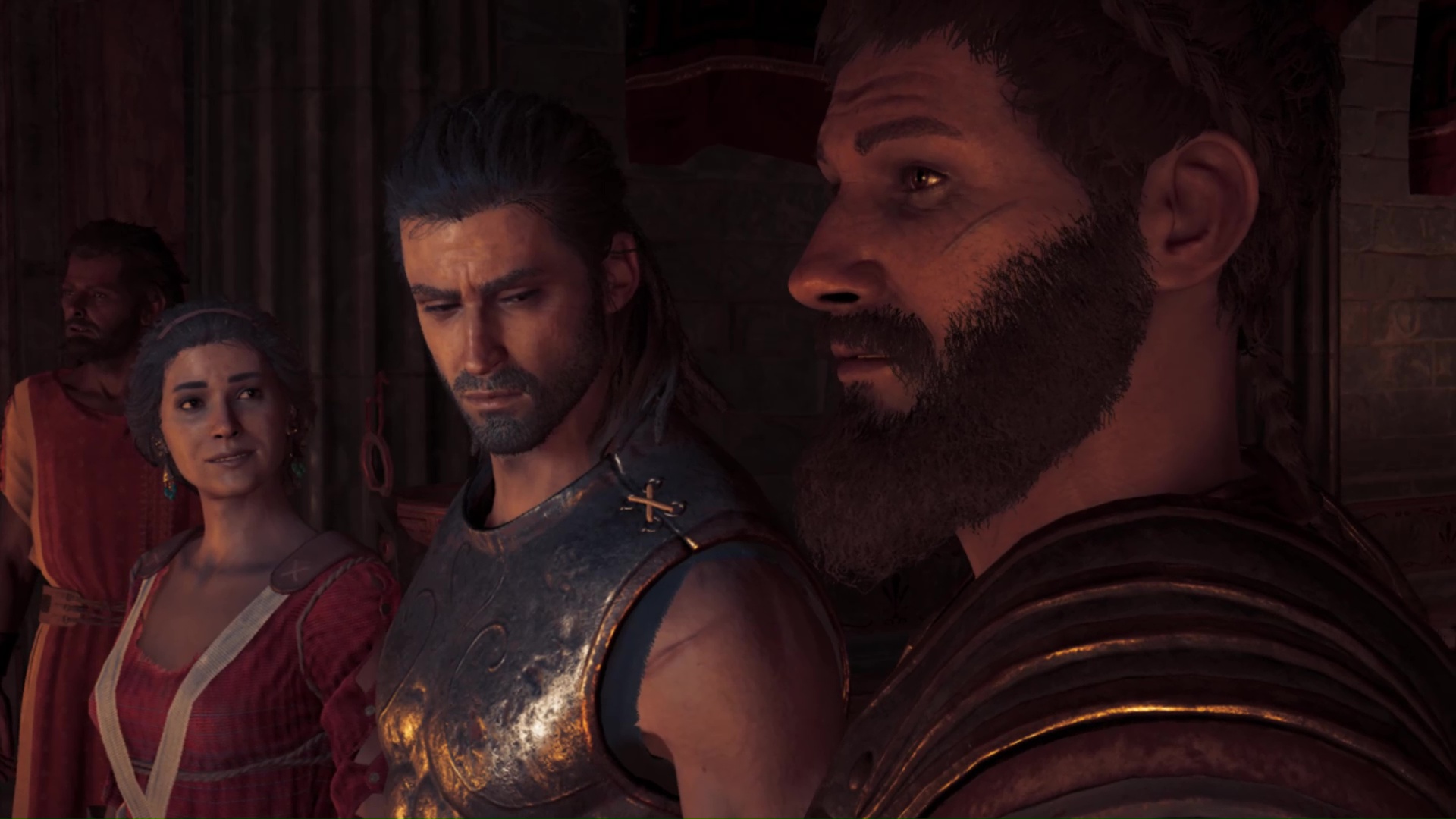
As much as I love replaying Odyssey, in my opinion nothing beats that first time exploration and discovering everything from the beginning. For this reason, I decided to record a playthrough in New Game, where I start from Level 1 and get everything from the start. There is a lot of grinding of course, which for some people may be tiresome or boring, but personally I enjoy it in this kind of games, and Odyssey especially which, moreover, is among the games that I love the most. My intention was to reach Level 99+, but after covering everything (and more), the highest that I managed to achieve was Level 82.
What I cover:
Basically all the stories and everything that is on the map, namely:
-The main Odyssey story
-The modern day story
-The Gates of Atlantis (the four artifacts)
-From The Shadows (the Cultists questlines)
-Legacy of the First Blade
-The Lost Tales of Greece and the two special blue-colored bounties
-The Heir of Memories including the three Underworld episodes (Elysium, Underworld, Atlantis)
-The Korfu addendum
-All the quests that are / appear on the map with the yellow exclamation mark
-A few random extra quests that are triggered after a certain action is done
-All map objectives that are marked with a question mark, including tombs, forts, camps and caves, temples, underwater locations, leader houses and other buildings and points of interest.
-All legendary items including armors and weapons that can be found by killing mercenaries or looting legendary chests.
How I play:
Instead of upgrading stuff, I rather switch to stronger weapons when I find them and regularly dismantle those that I don't use. Same goes for armor pieces, which may result in Alexios having a weird or even funny look at times due to random combinations, but I don't mind that and I also find it a bit entertaining, to be honest. I don't do any engravings, and instead I invest in upgrading the ship, which is vital for the naval battles later on.
Each episode covers one region (or more in a few cases when they are brief), with the necessary occasional backtracking or side-tracking to start or (fully or partly) complete a quest or kill a cultist. Most episodes include several quick backtrackings, but the respective regions are not included in the titles - for instance, Phokis is not listed every time that I return to Daphne, nor is Attika whenever I return to Demosthenes, but usually (if not always) backtrackings of this kind are done at the end of each episode. Sometimes I may intentionally leave out certain areas because I know I will be backtracking there in a later episode. For example, because the Lost Tales of Greece do not become available until after you complete the main quests in Athens, you cannot go for the two of them (Daughters of Lalaia and Socrates's Trial) that take place in Phokis the first time you visit that region. So I ignore some of the map objectives there in order to complete them when I revisit Phokis for those two quests. Because I may pass from areas, however, without going for quests the first time, weird things may happen, like the pirate ships from "A Really Really Bad Day" being destroyed long before said questline is initiated. I guess such goofy things are doomed to happen anyway.
Difficulty level:
I wasn't sure if I should go for Hard or Nightmare for a New Game playthrough, but I finally decided to go with Hard for three main reasons:
-Since it takes a long time to decently upgrade the ship, the Adrestia is quite weak for most part of the main story, which renders certain naval battles a royal pain in the arse when you play in Nightmare.
-There are a few parts in Legacy of the First Blade that are really exhausting in Nightmare, and since this DLC is not my favorite anyway, I didn't want to complicate things further.
-Certain quests in the Atlantis episode, namely hunting down the Dikastes's armor pieces, are extremely difficult because the Isu polemarchs that hold said pieces are insanely strong and resilient, so I needed this to be a bit toned down since Alexios is not super-powerful yet.
I recently reinstalled this gorgeous game in order to play its seven DLC stories that I already had aquired but had forgotten about them completely. They turned out to be absolutely wonderful, but in the process I realized that although I own the game since many years now, I had never attempted to play it in its hardest difficulty level, which is Deadly Obsession.
In reality, Deadly Obsession is not exactly a difficutly level. If you have played the game in its standard hardest mode, One With the Jungle, you already have mastered its most difficult version. Deadly Obsession is essentialy the One With the Jungle difficulty minus the automatic checkpoints. You can only save on base camps, and thankfully the game offers a few free checkpoints during sequences that are too extended or too demanding, namely:
-During the prologue, due to the lack of base camps, there is one free checkpoint just before you meet the local archaeologist outside the dig site.
-Again during the prologue, there is one more checkpoint when the flood begins.
-After the plane crashes and you find yourself in the Peruvian Jungle (kind of useless since there is a base camp pretty close).
-After leaving Paititi on boat and Rourke's helicopter attacks, Lara finds herself alone on the beach of the Porvenir oil fields. There is a checkpoint just before the series of areas where you need to move with stealth because you have no weapons.
-In San Juan, there is one last checkpoint at the beginning of the mudslide (thank God for that, because I died about a dozen times during that evil mudslide).
I played Deadly Obsession in New Game Plus mainly because I wanted to stay focused on the progression of the game without having to worry about leveling up, which would require going for side quests and challenge tombs so as to gain as many XP as possible. Lara is wearing the outfit of Six Sky for the most part, which helps avoiding a certain amount of damage from projectiles and regenerating health faster. As I mentioned above, the actual level of difficulty in Deadly Obsession is more or less the same as in One With the Jungle. What makes Deadly Obsession so nasty is the lack of checkpoints, which results in certain sequences being extremely hard to complete, not because they are difficult but because of all that climbing and jumping where there is hardly any room for mistakes. Playing with all skills or with no skills doesn't make much of a difference, because you are much more likely to die from a stupid fall or a miscalculated jump than from gunfire. I would say that the percentage is 90%-10% (90% for fall deaths, and 10% for the gunfire), or even 95%-5%. To be more specific, there are certain sequences that are guaranteed to test your nerves and your patience.
-The Trial of the Eagle. This whole part is a test of precision, where most of the times you will find yourself being knocked off to your death by an unforgiving beam. And when you finally manage to reach the top, you will most likely miss that last jump to solid ground. But at least there is a base camp just before the trial room, so you "only" need to repeat the whole trial over again.
-The Cenote stage. The lack of base camps in this section is pure evil. The stage per se is alright, with maybe the first Yaaxil ambush taking you by surprise, but I died only once during that part, and in the end I was able to kill most of them with Dodge Kills, preserving lots of valuable ammo. The water puzzle itself is quite easy to memorize, and the subsequent part where you need to escape the Cenote can be done easily too. But then it's the hard road back to Paititi. Although "road" isn't the word to describe it. You need to make a series of jumps above an abysmal chaos, where Lara suddenly may decide to commit suicide for no obvious reason. This means that you are then forced to repeat the whole Cenote part from the beginning, only to find yourself again in the dreaded situation of falling to your death while struggling to perform a lateral jump inside a peaceful, enemy-free cave.
-The sequence where you go to free Unuratu. The path to her cell involves a ton of climbing and jumping, and several times you will find yourself totally helpless while witnessing Lara falling right into the raging waters and breaking all her bones on the rocks. Then you will be holding your breath while struggling to survive the ambush in the yard of the Emperor's Tomb, although technically this should not be as bad as it looks as long as you have resources to keep crafting special ammo and are able to move around with stealth.
-The Porvenir Oil Fields. There is a base camp just before the second part, which I thought I would take advantage of to go back and save after completing a new area. It worked for the first area, but when I went back to save again after the second one, I saw that the enemies there had respawned. I don't know if this was done on purpose or if it's a leftover, but it was very annoying, and more so because there is again a nasty sequence with jumps afterwards, where of course Lara had to suffer a humiliating death more than once. I wanted to make those saves because I was dreading the helicopter part at the Refinery, but this went surprisingly well.
Overall Deadly Obsession was quite an experience which however I don't know if I am ready to relive any time soon. I also got the achievement with this run, but unfortunately Bandicam does not record Steam pop-ups, so it didn't capture the achievement popping up. My general impression is that, when it comes to games that rely so much on their platformer aspect, it is very risky to not give the players the chance to save more often (or at least change the placing of save points to be a bit more forgiving) when it comes to challenges like Deadly Obsession. Resident Evil 3's Inferno and The Evil Within's Classic Mode also don't have checkpoints, but those are both games that rely almost entirely on the player's strategy and you are able to be in total control almost all the time. In games like Shadow of the Tomb Raider, where you are many times found in the tough position to perform series after series of very risky jumps in between demanding battle sequences, a few more checkpoints or a couple more bonus base camps could make a huge difference and save us from unnecessary extra frustration.
The last playthrough in my Tomb Raider Nostalgia Series is that of the very first game, both of the classics and the series as a whole. The original Tomb Raider game is a pure vintage gem with so much sentimental value that it makes up for the fuss that you have to go through in order to decently run and record it on a modern computer system.
The resolution is a bit low in the main game, but everything is smooth and running well in Unfinished Business, the Gold expansion, which, by the way, is one of the two classic Tomb Raiders that I have played less (along with The Lost Artifact, as I mentioned in my Tomb Raider III report). Now playing UB again, I remembered why: although it is beautiful visually and very elaborate as far as gameplay and puzzles are concerned, I soon got fed up with those mutant mummies with their annoying (insert non-decent characterization here) screeching noises. Regardless, the Gold expansion, like the main game, is a lovely game, and very interesting too from a technical aspect, because in it you can see how elements from the main game were expanded to an impressive degree.
Like with all previous playthroughs of this series, I don't go for all pickups and kills (although I complete most of these objectives), but I do find all the secrets in every level. I have again split the playthrough in parts, one per region.
Part 1 is Peru: Caves, City of Vilcabamba, The Lost Valley, Tomb of Qualopec.
Part 2 covers the Greco-roman levels: St Francis' Folly, The Colosseum, Palace Midas, The Cistern, Tomb of Tihocan.
Part 3 is Egypt: City of Khamoon, Obelisk of Khamoon, Sanctuary of the Scion.
Part 4 is Atlantis: Natla's Mines, Atlantis, The Great Pyramid.
The last part includes the four levels of the Gold expansion "Unfinished Business": Return to Egypt, Temple of the Cat, Atlantean Stronghold, The Hive.
Next up in my Tomb Raider Nostalgia Playthrough Series is Tomb Raider 3, the third installment of the classics. There were quite a few innovations in this game compared the to the first and the second, the most memorable being the fact that, after the first section was completed, you could play the subsequent three adventures in any order you wanted. Like in Tomb Raider 2, a brief but fabulous bonus level would unlock if you completed the game with all secrets found.
Since these playthroughs are going to be a one-time thing - that is, I will probably won't be replaying the classic Tomb Raiders in full, any time soon at least - I am trying to cover as much stuff as possible. Random kills or pickups that have no interest or are simply in the regular path, may be left behind, but I do find all the secrets and if there is exploration involved (including pickups) in areas that are optional, I go for them as well. In this game in particular, I am referring to the legendary River Ganges level from the India section, where at some point you have to choose between two possible paths. At first, covering both paths was considered impossible, but later several players found out a way to visit them both. In my playthrough, I also do this; I cover both paths so as to explore as much of the terrain as possible. All this involves some really tricky jumping that may even put to shame many contemporary games that are considered difficult in that aspect. You can choose between paths in other levels as well, but in those cases you cannot cover both alternatives, so I will be taking the longest possible path.
This game includes one of the toughest sequences I have ever encountered in gaming - and trust me, I have played many difficult games! I am referring to the notorious kayak sequence in the Madubu Gorge stage of the South Pacific Islands section. Driving any vehicle is a tough business in the old Tomb Raider games, but the kayak is on another level. In fact it is almost literally an up-the-creek-without-a-paddle kind of level, almost because you do have a paddle but it's a royal pain in the ass anyway because even though you have a paddle, those wild rapids are definitely the devil's work. At the same time, it's a quite fascinating experience, because who can forget the impressive finale with Lara driving the kayak down that roaring whirlpool.
Tomb Raider 3 also includes one of my most cherished sections, the one that takes place in London. This section is perfection, even with today's standards. In its turn, it features one of the most difficult sequences in the whole series, the flooded / underwater section of the Lud's Gate stage. Like in the Tomb Raider 2 playthrough, in this one too I have included its Gold expansion, The Lost Artifact. Each video covers one section of the main game, and the Lost Artifact has its own separate video.
A NOTE ABOUT THE LOST ARTIFACT: this is the one of the two classic Tomb Raider games that I have played the least (along with TR1's Gold expansion) - which is weird, by the way, given how much I like most of it. Moreover, the only working version of it that I could find (that is, the only version that would even load on my Win11 PC) was an extremely buggy one that featured every single bug that has been reported so far concerning this game. For these reasons, I didn't insist much on achieving good scores, as I just wanted to record a playthrough for historical reasons mainly. Regardless, all secrets are again included, as well as almost all the pickups that are well-hidden or require taking complex routes.
Part 1 is India, the introductory section including: Jungle, Temple Ruins, The River Ganges, Caves of Kaliya.
Part 2 is Nevada: Nevada Desert, High Security Compound, Area 51.
Part 3 is the South Pacific Islands section: Coastal Village, Crash Site, Madubu Gorge, Temple of Puna.
Part 4 is London: Thames Wharf, Aldwych, Lud's Gate, City.
Part 5 is Antarctica: Antarctica, RX Tech Mines, Lost City of Tinnos, Meteorite Cavern.
Going on with my Tomb Raider Nostalgia Playthrough Series, I am now playing Tomb Raider: Chronicles, the fifth game of the classics.
I remembered Chronicles fondly, and when I started to play it again after so many years I realized why, but then I got to the notorious VCI section and everything got a bit messy. The last three levels of the game are among the best of the classic Tomb Raiders, and maybe the most original and innovative compared to the rest of the series of that era, but at the same time they are so hard and so incredibly buggy that eventually the VCI adventure turns into an assemblage that could only be compared to Stefano Valentini's morbid creations: on the one hand the bugs can be hellish; from frustrating to literally game-stopping. Although sometimes said bugs may also have fortunate outcomes: as you will see in my video, at some point I tried to make Lara stealthily neutralize a guard, which she refused to do; at that point, the guard surprisingly turned around and left the room, totally ignoring her, so I managed to go on with the level undisturbed. In an other section, a ceiling trapdoor that was supposed to open never did so, but Lara was nonetheless able to climb in the room above; the consequence of this was that two extra guards that were supposed to appear when the trapdoor would open, never showed up. I am not complaining for bugs like these. On the other hand, there is great atmosphere in the VCI, fantastic stealth sequences, enemies that are not only tougher than usual but also cunning, and some of them have traits or accessories that make them extremely hard to kill. Lara doesn't have her trademark pistols, which means we don't have the unlimited ammo luxury available, and the developers have implemented new elements, like having Lara equip a rifle with a scope for the first time, as well as a grappling gun, and use chloroform to neutralize the enemies while moving with stealth. Considering all that stuff in retrospect, I am thinking now that the three VCI levels (The 13th Floor, Escape With The Iris and Red Alert!) were maybe an attempt to prepare the ground for a - then - future Tomb Raider that would probably shift towards a different direction, a game that could have elements of stealth and heavy action involved; something that unfortunately never happened back then.
Setting that aside, however, the rest of Chronicles is pure old Tomb Raider as far as the stories and the environments are concerned, with the Rome section being a reminiscent of Venice from Tomb Raider 2, and the Submarine levels bringing back memories from Tomb Raider 3's Antarctica. The Ireland section, in which we get to play with a teenage Lara, is also somewhat different, because our heroine doesn't have any weapons in those levels - thankfully there are neither enemies that need to be shot - and the whole story is set around local folklore and magic.
Like in the previous - as well as in the upcoming - playthroughs of the classic Tomb Raiders, here too I am not going for all kills or pickups, but I do find all secrets in each level. That said, if a pickup is very tricky and challenging, I do go for it anyway for the sake of exploration and discovery which are both so important in Lara's adventures. My playthrough is split in four parts:
Part 1 is Rome: Streets of Rome, Trajan's Markets, The Colosseum.
Part 2 is The Submarine: The Base, The Submarine, Deepsea Dive, Sinking Submarine.
Part 3 is Ireland: Gallows Tree, Labyrinth, Old Mill.
Part 4 is the VCI Headquarters: The 13th Floor, Escape With The Iris, Red Alert!
At the end of the VCI section / video, I have also left the flyby's that show after the credits, because they offer some interesting bonus scenes.
My second favorite from the classic Tomb Raiders after the Last Revelation, and the second that am playing in my Tomb Raider Nostalgia Playthrough Series, had always been Tomb Raider II, what with its emblematic Venetian environments and music, its complex puzzles and sceneries and its unforgettable arch-enemy Marco Bartoli. Like with my Last Revelation playthrough (you can read the report and a brief intro for this series of playthroughs here), I play mostly from memory, and for this reason I am not getting all pickups or kills, but I do go and find all the secrets in every level, and if a pickup is tricky or challenging, I do go for it (like the legendary Uzis in the first level of The Golden Mask expansion).
Again the run is split in parts.
Main game:
Part 1 includes The Great Wall intro and the Venice levels: Venice, Bartoli's Hideout, Opera House.
Part 2 I call it The Deep Sea, and it includes the levels that take place at the rig and on the Maria Doria shipwreck, namely: Offshore Rig, Diving Area, 40 Fathoms, Wreck of the Maria Doria, Living Quarters, The Deck.
Part 3 is Tibet: Tibetan Foothills, Barkhang Monastery, Catacombs of the Talion, The Ice Palace.
Part 4 is China: Temple of Xian, Floating Islands, The Dragon's Lair, and the Home Sweet Home epilogue.
The Golden Mask adventure covers the last part, the Gold expansion of Tomb Raider II that consists of five levels: The Cold Cold War, Fool's Gold, Furnace of the Gods, Kingdom, Nightmare in Vegas.
I decided to replay the classic Tomb Raider games, in a series which I am calling "Tomb Raider Nostalgia Playthrough Series". By the term "classic Tomb Raiders", I refer to the first five Tomb Raider games (1-5) and their Gold expansions or add-on levels, that were released from 1996 to 2000. The classic Tomb Raiders were among the very first video games that I played many years ago and the first of the Action/Adventure genre that I ever had the chance to know. I was an avid Tomb Raider player back then, having even developed a certain virtuosity, since I participated in extra hardcore challenges set around the "No Damage + Pistols Only" rule which, at times, proved to be extremely difficult. Since then, many things have changed, including the always evolving PC systems due to which running those old games now can be a real pain. The graphics look stretchy, the resolutions look weird and it's almost impossible to record the included FMV's the standard way. Thankfully, the player friendly gameplay system of the classics never stopped to work well, thanks to which we can still enjoy those gems on our modern machines. Although I have to admit that, after being used to playing with a controller for so long, I do find it a bit tough to have to use the keyboard again.
It's been a very long time since I last played any of the classic Tomb Raiders, so I decided to begin with The Last Revelation which had always been my most beloved of those first originals. Set entirely in Egypt (with the exception of a brief two-part training level at the start), this game was a revolution in its time (it was released in 1999) and it involved a fascinating story and amazing historical locations. Most of the game is played by memory (I confess I was pleasantly surprised as to how much of it I actually remembered!) and the rest by trial and error (and lots of edited-out reloads!) until I recalled or figured out the sequence of events and actions. Because of this, I do not go for all pickups or kills, but I do find all the secrets in every level, and if a pickup is challenging I do go for it anyway. Some of the strategies that I am using (especially against bosses or very tough enemies) are the ones I used back then while playing the "No Damage + Pistols Only" challenges, but of course now I am playing normally; at this point I am not interested in going for such challenges in these games, since my aim is to enjoy the gameplay like the old times and showcase the beauty, brilliance and complexity of the classics, as well as the potential of Lara's full arsenal in use.
I have split the gameplay in parts instead of a longplay, to maintain the vintage vibe and feel of gaming.
Part 1 is Cambodia, basically the two training levels: Angkor Wat and Race For The Iris.
Part 2 is the Valley of the Kings section, namely: The Tomb of Seth, Burial Chambers, Valley of the Kings, KV5.
Part 3 is Karnak, including: Temple of Karnak, The Great Hypostyle Hall, Sacred Lake, Tomb of Semerkhet, Guardian of Semerkhet.
Part 4 is Alexandria: Desert Railroad (basically this is an independent level, but I have included it in this section because the train literally brings Lara to Alexandria), Alexandria, Coastal Ruins, Catacombs, Temple of Poseidon, The Lost Library, Hall of Demetrius, Pharos - Temple of Isis, Cleopatra's Palaces.
Part 5 is Cairo: City of the Dead, Chambers of Tulun, Citadel Gate, Trenches, Street Bazaar, Citadel.
Part 6 is Giza including: The Sphinx Complex, Underneath the Sphinx, Menkaure's Pyramid, Inside
Menkaure's Pyramid, The Mastabas, The Great Pyramid, Khufu's Queen's
Pyramid, Inside The Great Pyramid, Temple of Horus.
The last part is the standalone Times Exclusive Level.
UPDATE NOTE: I had to reupload some of the videos to fix some technical issues. If you want to watch them in order, follow this playlist, either here or in my YT channel.
This playthrough is a new and improved "No Merchant" gameplay of Resident Evil 4 in Professional difficulty, New Game, this time with the addition of the "No Damage" rule. A "No Merchant" playthrough of Resident Evil 4 means that you completely ignore the merchant throughout the whole game, which means that not only you cannot upgrade your weapons and your attache case at his "store", but moreover - and most importantly - you cannot buy any other guns from him. Plainly put, you are limited to your default inventory as is, plus the very few extra weapons that you come across in the game itself, namely the Shotgun (chapter 1-1), the Broken Butterfly (chapter 4-1) and the two Rocket Launchers (chapter 3-3 and Final chapter). The "No Damage" part of course consists in sustaining no injury at all.
I saved a lot in this playthrough, and I also had to reload a lot. Sometimes because Leon would get hit, but most of the times because I thought I'd try a different - and better - strategy, and more so, since I hadn't played the game in a long time, and I needed to refresh my gaming memory regarding certain sections.
Chapter 1
The first chapter of the game is very easy, even in Professional. There is really not much difference in a "No Merchant" run, as even in a regular playthrough the upgrades that you can make are very few anyway. What really makes a difference though is that, since you cannot buy anything from the merchant, you will never get a Rifle in your hands, although you will not really feel the lack of this kind of weapon until much later. The most difficult part is the start of sub-chapter 1-2, where you have to make your way through about 50 ganados while looking for the two pieces that open the exit gate. I found it better to knife or shoot them dead instead of ignoring them, so that I would avoid any nasty surprises.
Chapter 2
The second chapter is a bit harder, but this only becomes evident during the Cabin Fight with Luis in sub-chapter 2-2. The thing is that, since you cannot make any upgrades, your Shotgun is limited to carry 6 bullets each time, which means that you have to reload way sooner that you'd like to. In any event, I followed more or less the same strategy that I usually apply in most of my playthroughs: I just stand at the top of the stairs for the first part, shooting any ganagos that may attempt to approach in groups, then in the second part I make sure to drop the ladders around the windows and keep close to Luis as much as I can.
The worst part for me this time was the boss fight with Bitores in the barn. The first half of the battle was easy, as I did the same trick that I always do, both during my New Game runs and in my Handgun Only challenges - I shot him from a safe spot from the rafters until he mutated into his second form. The following part of the battle was the worst, as sometimes he would scratch Leon and even fatally wound him without the game giving me a prompt to dodge his attack. Moreover, he is quite fast and most of the times grenades are too slow to get him. So what I did was that I threw a Flash Grenade when he was close to the floor to make him drop, then threw a Hand Grenade while he was still down which then gave me the time to throw Fire Grenades before he could fly high up again. This sequence wounded him enough, and so soon after the fight was finally over.
Chapter 3
As the game progresses, it becomes harder, as expected. The third chapter is where you start wishing you had a Rifle and a few upgrades in your guns. The Prison was a bit of a pain, as I didn't want to waste much Shotgun ammo on the Garrador, so I additionally used the pistol and the knife to hit his plaga. This strategy made the battle last longer than I'd want to, but I already knew that as long as you keep walking around instead of running, you are relatively safe.
Then was the accursed room with the pools and the crank. This section is a nightmare even in regular gameplay, let alone in a No Merchant/No Damage challenge. Not only are the Zealots endless, not only way too many of them carry shields, but as if all this wasn't enough, their plagas are infuriatingly resilient. To add insult to injury, the two archers on the sides of the room will most often than not be able to hit you after you have cleared the whole room, which means that you have to replay this whole part from the start.
Afterwards is the part where you have to protect Ashley as she is turning the two cranks, by shooting the Zealots that get close to her and / or manage to grab her, while at the same time a decent number of other Zealots come running to Leon in a fury. It is one of those desperate times when you'd offer your kingdom for a Rifle; and the Shotgun can only cover Leon's close encounters with the Zealots as it is not only unable to shoot away the monks that are up on the bridge with Ashley, but it is also too risky to use it as its wide shooting range can hit the girl and kill her before you know it.
Moving on, I was not sure how to proceed in the Sewers with those disgusting giant insects, until I decided to just run past them, ignoring them completely and hoping that they wouldn't hit me or surprise me around a corner. After a few attempts, the plan worked and I only missed those items from the cells; but I would have wasted way more ammo had I decided to fight and kill the monsters. The room where the Goat Ornament is was a bit frustrating, but again I found it better to simply run through, shooting only those enemies that would stand in the way. The Zealots with the Rockets hiding behind the painting were quite helpful, as their shots would kill a few monks every now and then.
The rest of the chapter was a breeze compared to what came before; I just run through the hedge maze not killing any plaga dogs, then in the Garrador room I tossed a Hand Grenade to temporarily neutralize him, kill a few monks and, most importantly, break open one of the cage doors. Freeing Ashley from above was rather nasty, though; again for the same reasons for which the room with the two cranks was a nightmare. Since I had no Rifle, and I couldn't risk using the Shotgun much in case I'd kill Ashley, I relied mostly on my handgun. Those Zealots could never go down, and as long as the leader was alive, more minions would burst in the room. Ashley's part is always easy and fun, so the chapter ended in a relatively relaxed mood.
Chapter 4
After having completed the game for this challenge, I can safely say that Chapter 4 is by far the most difficult section when you play in No Merchant / No Damage mode. There may be certain parts in Chapter 5 that are extremely tough, but the fourth chapter is a nerve-wrecking experience from beginning to end. One of the highlights of course is the room with the knights that guard the King's Grail. Of course I had the Broken Butterfly, but I had to be very careful to never miss a shot. Thankfully, I had enough Flash Grenades to kill the plagas after the knights mutated.
After placing the two Grails and dealing with the giant insects in the Hive room, I went the long way back to the room with the free Rocket Launcher and took the gun, although at that point I wasn't sure against which enemy I'd use it. Surprisingly enough, I had no problem dealing with both Garradors at the Clock Tower. I slowly lured them towards the entrance of the room so as to not trigger the appearance of the extra Zealots, and managed to kill them one by one, patiently and strategically moving around.
Arriving at the Sewers, I decided to use the free Launcher to kill the Verdugo, although I knew I could simply dodge his attacks and wait for the elevator to arrive, as killing him is not required so as to move on (it is an alternative strategy I had already done in my Handgun Only runs); but I decided to kill him for two reasons: one, after going through the nightmare that was sub-chapter 4-1, I didn't have the courage to play hide and seek with that disgusting giant cockroachy thing; and two, because keeping the Launcher in my inventory would dramatically limit my carrying space as far as ammo was concerned.
At the two Gigantes room, I lured the one in the lava pit (thankfully it was the hardcore one), then used the well-known ladder trick to knife the other like there was no tomorrow. It was a bit time consuming, but killing him with gunfire would mean losing a ton of valuable ammo. Then it was the insects cave, a section that I hate with a venom. Not only are those giant mosquitos disgusting as hell, not only they make those creepy noises as they fly around or run about the cave, they are also able to take you by surprise just when you think you are safe from their reach. I took advantage of the checkpoint system in this room, by exiting and entering the cave after each successful run to a button, and only shot down those insects that would truly cause trouble. There was no way I would waste my valuable Shotgun bullets on those creatures.
Next up, the mine cart ride was an expected highlight. A rather easy section when you have the Shotgun, but for some reason I wasted way too many bullets this time, and when I arrived at the room with Salazar's statue, my inventory was poor as Hell. I moved on anyway, and at the Tower of Death I just run upstairs and boarded the elevator. After dealing with all the Zealots during the ride, I had only a few ammo left, and only hoped that my magnum bullets would be enough for the battle with Salazar.
That is when I realized that using the Launcher against the Verdugo instead of keeping it for Salazar was a really bad idea. Salazar proved to be one of the nastiest and toughest bosses in all Resident Evil history, which is quite impressive for an enemy who cannot even chase you around. Of course my magnum bullets were not enough, and shooting him with the pistol or the Shotgun felt like throwing grains of sand on an iron wall and expecting it to break. I nearly gave up at that point, but then I used Mathematics and they saved me. Salazar's HP is approximately 250; the Broken Butterfly has 13.0 HP. This practically means that you need about 18 - 19 magnum bullets in order to kill him. I only had 15, so I needed to arrive at the battle stage with at least 4 bullets more. Thankfully, I had a save from the start of sub-chapter 4-4, so I reloaded that part and was lucky to get a few more magnum bullets as a random drop from the Zealots there. With the addition of the magnum bullets that you find just before Salazar's arena, I now entered the battle room with 21 magnum bullets. What I did was that I simply stood opposite Salazar, dodging his insta-kill attacks and the hits from his tentacles, and shot him carefully every time his "body" was exposed. That is, I didn't waste any bullets to break his eye and make his body appear, I simply waited for him to open his cocoon and expose himself on his own. It took a bit of time, but I managed to not miss a single shot, and after hitting him enough, I saw the long-awaited cutscene where he wails like a failed opera singer before disappearing for good.
Chapter 5
The last chapter of the game is traditionally the most demanding, but for some reason it didn't cause me many problems this time around. I managed to go through the first part without killing almost anyone, and avoiding JJ's machine gun by either hiding or tossing Flash Grenades to stun him. I followed a similar strategy for the next part, just ignoring the soldiers until I reached the gate and subsequently entered the building.
For the Regeneradores - at least those that are necessary to kill - I used the shoot-and-slash strategy that is so effective and saves you from wasting ammo; and the same I did for the Iron Maidens. The hardest part is definitely the lava room in sub-chapter 5-2; but this time I came up with a different strategy that worked wonders. I jumped down with Ashley, then run to the right and around the lava pool, headed towards the left door of the control room. Just there, I tossed a Flash Grenade, stunning most enemies and giving Ashley enough time to operate the wrecking ball twice before the ganados would start to wake up again. At that point, I tossed one more Flash Grenade, Ashley operated the ball one last time and we managed to run out safely with plenty of time in our hands.
The bulldozer rides are almost always a fun part (unless you play with handgun only; then they are no fun at all). Next up was the knife fight with Krauser. Such a great scene and so many fond memories from my first runs of the game. Unfortunately, I had forgotten that you need to press two buttons in a sequence at the end of the scene, so Jack managed to kill Leon the first time. This was one of the many deaths that Leon had in sub-chapter 5-3.
Then it was the dreaded U-3 battle. It went unexpectedly well this time, however, and I only had to reload just a few times because the damned thing somehow managed to cut Leon in half. There is a dramatic FPS drop from time to time as the U-3 chases Leon around, but nothing too distracting, thankfully. I used the Broken Butterfly, many Fire Grenades and my knife in order to kill the monster and it was over sooner than I expected.
The boss fight with Krauser is a classic part, and I knew I was going to kill him with my knife only. All went smoothly until the final stage, because I didn't remember how fast, furious and flexible Jack would become after his mutation, and Leon ended up dead more times than I could count. In the end though Jack succumbed to Leon's blade like he always wanted to.
Sub-chapter 5-4 is a challenge on its own, especially in Professional where Mike only shows up once then forgets about Leon almost completely. The part with the three mounted guns is one of the worst sections; but then I followed a strategy that I had come up with during my Handgun Only runs, going first to the leftmost tower and dealing with the arriving soldiers from there, then carefully moving behind the ganado who was operating the machine gun and killing him. I then moved to the opposite tower and carefully killed the other ganado on the rightmost mounted gun, before dropping down and, moving with caution from barrier to barrier, approaching the ganado on the ground-level mounted gun and eventually killing him.
The final part of this sub-chapter turned out to be one of the most frustrating parts of the game. Attempting to kill the soldiers seemed like an option, but they are all so strong at that point that it seems like it's a waste of bullets and time to try and deal with them. So I just run straight to the locked exit door, thus triggering the cutscene where the soldier with the red bandana removes the card from the control slot and runs down to where Leon is. I was lucky this time because when he arrived he was on his own, and I managed to kill him and take the card almost immediately. Again taking advantage of the checkpoint system, I exited and entered the arena after each successful run to a button, until I finally managed to leave that damned place. One more good thing about this strategy is that, as long as you don't kill enough soldiers, the JJ enemy will not appear.
The boss fight with Saddler was like a walk in the park in the end. I used grenades, the barrels and the cranes to stun him and be able to stab his eye enough times to trigger Ada's appearance, then used her Rocker Launcher to send him to his grave. After all that we've been through, it was the least we could do to reward ourselves for our achievement.
Addendum: Separate Ways
Ada's
story in "No Merchant + No Damage" mode doesn't make much difference
compared to a regular gameplay, because "Separate Ways" has a fixed
difficulty level (I guess it's a slightly enhanced version of Normal)
and Ada cannot boost her weapons as they already have a few
predetermined upgrades. The challenge here lies in her not being able to
buy the extra guns (the TMP, the Rifle and the Crossbow), but the times
where you truly miss having those weapons are extremely few. Moreover,
you can just run past most enemies, sometimes even bosses (namely, the
Gigante in Chapter 2), while grabbing all the items in an area.
The
only truly difficult parts, but still manageable, are the shipyard
section in Chapter 4, the locked room with the timer in Chapter 5 and
the camp part with the archers and the two JJ's in the same chapter.
Other than that, both Krauser and Saddler can go down pretty fast with
the knife, and you can simply run past everyone - or tossing grenades,
like I did - during the final part.
This is my Inferno playthrough of Resident Evil 3 Remake, without taking damage and without using any shop items. It is the most challenging mode of the game, this time in its raw edition, as I am not making use of any perks that would make the gameplay slightly easier. Specifically, I am using the default inventory for Jill and Carlos, and I pick the other items as they normally appear in the game.
Inferno is several scales higher than Nightmare; not only are the enemies much tougher, but also the amount of bullets that you can pick up or craft is minimal. There are no automated checkpoints to aid you and several typewriters are absent, which means that you are required to go through whole areas without being able to manually save at all. My first Inferno run was with a few shop items included, but even then it was tough as Hell. After beating Nightmare without perks, however, I thought I'd also give raw Inferno a try.
In practice, it is not as bad as it may seem or sound, given of course that you should have already practiced enough with playing the game in Nightmare. I wouldn't say that Hardcore helps; the game is much different in Nightmare and Inferno, so if you want to beat Inferno, practicing with Nightmare seems to be the best choice. Even so, Inferno is a lot more difficult, and more so since you find less items scattered around, therefore you are called to think well and decide how (and if) to waste those valuable bullets.
In Inferno, the game gives you one extra pouch and the Magnum as soon as the main game begins, at the Subway ticket office. Still, you have to use this very strong weapon wisely, as the amount of ammo that you can craft is extremely limited. In this run, I used the High Grade gunpowder to make ammo for the Magnum strictly, and the standard gunpowder to craft handgun bullets, as the ammo that you find for the Shotgun is more or less enough to last you during the demanding sequences.
This playthrough is not a playlist, as the game is relatively short and cutting it down breaks the action. The full video can be found at the end of this article, as always. Disclaimer: the following report reflects my own experience and the strategies that I found to work well according to my own play style.
Uptown: the intro of the game is rather easy and straightforward and the only thing that you really need to worry about is dodging the extra zombie that is standing by the gate beyond Jack's Bar (also appears in Nightmare), and then the elevator zombie at the parking garage. If they do not take you by surprise, you can easily evade them both; even simple dodges can work as long as you time them right.
Downtown: there is no typewriter in the Donut Shop, which makes things quite tight, and going back to the station to save is out of the question, as the back alley that leads there is still crawling with zombies, so everything before putting the fire out has to be done flawlessly, in one go. You have to keep in mind that in Inferno the 'no damage' rule is a prerequisite in order to make it safe, as the grand majority of attacks will either one-hit kill you or put you in Danger state, so losing no health is a must anyway when you play in this difficulty. After obtaining the Bolt Cutters and the Lockpick, I backtracked to get all those locked items from the shops, offices and alleys. The back alley near the station was by then zombie-free, by the way.
Power Substation: I usually kill most of the Drain Deimos, but Inferno is not a mode where you waste ammo, so I just ran along the paths killing only those that were truly a threat and dodging / running past all the others. It was much easier this way, but I was also a bit lucky this time.
Downtown again: when Nemesis smashes the wall outside the Substation and starts chasing you, is where the real fun begins. There are two extra zombies blocking your way just around the corner, and one more banging the door of the garage. Thankfully there is a typewriter there, to which I also return to save after setting the route in the Subway office. It means a bit of backtracking, but I don't mind that if I can save my ass.
Sewers: this section is not so difficult as it is annoying, what with the Gamma Hunters being so creepy and disgusting, and the bonus NE-α zombies that sometimes look like they have been killed but they may still be alive. During my initial playthroughs of the game, I could never for the life of me dodge the Gammas, but Inferno made me learn to do it as it was a matter of life or death (literally).
Demolition site: the first boss fight with Nemesis looks like a pain, but can be completed fairly quickly and safely as long as you don't let the boss flood the rooftop with flames and you keep it away from Jill. I kept my grenades especially for this fight, as Nemesis in this form can evade any other shot and cause you to both miss your target and waste a valuable bullet. I never bother stunning Nemesis with grenades during the Downtown section, because in Inferno (as well as in Nightmare) it will never go down with just one. This of course has a cost, as I miss the upgrades for the handgun and the extra ammo that the bonus cases provide, but those items are not that essential for the rest of the game.
Rocket Launcher Nemesis and Rolling Head sequence: this brief section I both hate and love. I hate the first part where you have to run like mad while evading the rockets that Nemesis fires at you, what with NE-α zombies getting in the way, but I love the rolling head sequence, which is probably my most favorite instance of the game (you can read my respective article here). The worst thing about this sequence is that you may get past both the rockets and the head only to get killed by the Nemesis while running to the back alley gate. Or, even worse, get past this whole part and return to the subway, then while playing with Carlos, get killed by the zombified Brad in the RPD courtyard.
RPD: a rather tedious sequence, mainly because you have to kill all the zombies in the West wing, and in Inferno their heads are made of cement. Not to mention that Carlos's default handgun is a useless peashooter. Even so, it is a relatively easy part, which however can end up pretty badly after you place the explosives. I always throw a flash grenade to stun the zombies beyond the exploded wall, but sometimes a palehead may get me as I burst out of the locker room door to the STARS corridor. Since there is no typewriter in the Dark Room, getting killed at that final point means having to repeat the whole section from the Main Hall.
Clock Tower Battle: one of the major fights of the game, which is quite frustrating because there are that many weapons you have to use in order to get done with it quickly. Jill needs half a century to reload that accursed Grenade Launcher, but thank God for the switch-weapon trick that is a life saver. Apart from that, and assuming you don't end up dessert, this fight is marginally entertaining, with the Nemesis performing parkour all around the Plaza for your viewing pleasure (not).
Hospital (Carlos): unlike in the lower difficulties, in Inferno there is only one typewriter in the hospital, and that's in the makeshift sickroom where Jill is, which translates in doing everything in one go, or backtracking every now and then to save there. I did the second, because you never know with those frigging Hunters. That said, I killed most of the zombies to keep the place clean for Jill, but didn't bother with the Hunters. Jill has a great advantage over Carlos: her dodge is much faster, more efficient and easier to perform, so I knew I could trust her with making it safe past those monsters. When I got to the ambush part, I had so little ammo to begin with, that I thought I wouldn't make it, but fortunately I did it almost first try.
Hospital (Jill): with almost everything cleaned up thanks to Carlos, I only had to worry about the Hunters with Jill. The first Hunter that you come across in the hall outside the Operating Room can be easily outsmarted with a simple trick: run in the hall to trigger it, then go back out the way you came, and it will go stand in front of the doors on the left. Then run (don't walk! You want the Hunter to hear you!) quickly to the small area beyond the glass doors on the right where the locker is, and the Hunter will run and stand in front of the Operating Room doors with its back to you. It will remain there as long as you walk in this area from that point and on, and will be no threat at all. As for the Hunters in the cassette room, I found it better to lure one of them outside, as this way it would be easier to dodge them separately if necessary, because I desperately needed that explosive powder.
Hospital underground: there is no typewriter in the office of the storage, but this doesn't cause any problems because the fuses sequence is so quick and so easy that it's no big deal replaying it if you mess up. There is almost nothing that can seriously trouble you, as long as you are careful and plan your moves anyway.
NEST Labs: here, however, the omission of the typewriter is a big deal, because of the Hunters that appear at the end of the section. The labs up to that point are quite easy to complete, but the Hunters are so fast and vicious, that you may end up heavily wounded or even dead before you know it.
Acid Nemesis: I normally rely on grenade rounds for this battle, but this time I had very few of them, so I followed a different strategy which turned out to be a lot safer and much quicker. The Shotgun seems to deal a dramatic amount of damage on the Nemesis, especially when the boss is in flames, reducing the times it will escape to do its parkour routine around the room, therefore minimizing the number of the zombies you have to fight as a bonus. In this run, I managed to sync perfectly with Carlos, and he did his trick with the acid, considerably weakening the Nemesis before I finally defeated it for the time being.
Final Boss: the most dreaded part of the game, and one of the worst boss fights ever. The level of difficulty seems to shoot up in that battle, which becomes one of the biggest challenges in Inferno. The only way to evade the Nemesis is to perform Perfect Dodges flawlessly, but this in fact is the easy part. What makes this battle so difficult is that the Nemesis (obviously in a state of extreme hysteria) shows off a series of cheap attacks that can cost Jill's life because they make her unable to move. Additionally, it has one specific potentially lethal attack that consists of performing several vertical slams in a row, that you have to dodge perfectly, during which sequence it may stop briefly at either the 4th, 5th, 6th or 7th slam and you never know which is going to be every time, usually resulting in a badly timed dodge and subsequent instant death. The Inferno version of this battle comes straight out of the deepest depths of Hell, but it gives you such a great sense of accomplishment when you succeed in completing it.
As an overall impression, I find Inferno very challenging and exciting, but also hellish, like its name says, with the amount of difficulty in certain sequences getting a bit unnecessarily frustrating and tedious. Still, the way the game is setup in this mode, along with the lack of checkpoints and the limited saving places, instantly creates a feeling of old-school gaming, which fits perfectly with the vintage mood and cultish character of the remake.
A playthrough of RE3 Remake in Nightmare difficulty. I am not taking any damage and I am not using any coins or infinite weapons. I do use a few other shop items, specifically: the Samurai Edge handgun and the Hot Dogger knife, the bonus pouches, the extra Lockpick and Bolt Cutters and the Crafting Companion.
In Nightmare, the game generously gives you the Magnum from the beginning, as well as one extra inventory pouch The Samurai Edge handgun is stronger and more stable, so I do prefer it over the default one. The Hot Dogger is of course stronger than the standard knife, but most of all it has this impressive burning effect. I use the bonus pouches so as to have more space, since I take the bonus Lockpick and Bolt Cutters from the item box at the station, so as to not have to backtrack to every locked place with zombies and the Nemesis breathing down my neck (grenades are unable to stun the Nemesis in this mode, so I prefer to run and dodge while it's chasing me). The Crafting Companion may not be that necessary, but it is helpful when it comes to crafting Magnum and Grenade ammo.
Nightmare difficulty is many scales higher than Hardcore, and features several instances that are quite intense. You are called to find new strategies to come around certain sequences, as things are quite different in this mode. The final boss fight is unforgettable once you are done with it; it is pure brutality and far more difficult than the rest of the game. This alone is not an issue per se, but it becomes a serious one when it does not allow you any kind of improvisation. I don't mind a tough challenge, as long as there is a logic behind it; and a boss battle doesn't have to be inhumanly difficult in order to be challenging. Just think of Saddler, the boss in Resident Evil 4, or Laura, one of the bosses in The Evil Within. You can fight Saddler using a great variety of weapons and means, even take advantage of the environment or simply use your humble knife. Laura is extremely strong, aggressive and lethal, but again you can face her in several ways; and during one specific battle, you can trick her, trap her and freeze her, and keep doing this while evading her attacks until you are able to run away from her without even killing her. This is what I call inventive gameplay. Inventive from the part of the
designers, but which also allows the players to be inventive and
creative themselves. The fact that you can face Saddler and Laura in many
different ways doesn't make the respective fights any easier. It just gives you time
to think and challenge you to plan out your own strategy. But when a battle requires from you to just press one button in just the right time so as to not end up mush on the floor and demands from you to do this constantly, like the final Nemesis sequence does with the required Perfect Dodge, does not make that battle more challenging, it makes it tedious and from a point and on, it prevents you from enjoying the grand finale.
My playthrough is split in five parts; the list below describes the sections that I cover in each one:
Part 1: Uptown (Jill's apartment), Downtown (Underground and Market), Power Substation
Part 2: Back to the Underground, Sewers, Demolition Site & Boss Fight, Downtown Revisited via Kendo's Shop
Part 3: RPD (Carlos), Clocktower Plaza & Boss Fight
Part 4: Hospital (Carlos and Jill)
Part 5: Underground Storage, Nest Labs & Boss fights from Hell